Skip to content

Private label soft kettlebells are not a general fitness trend. For a wholesale buyer, they are a product line decision. The question is whether the supplier can deliver a safe weighted product, a clean retail presentation, stable repeat production, and enough margin for distributors, gym suppliers, Amazon sellers, and boutique fitness brands.
A soft kettlebell manufacturer should understand more than fabric and filling. For B2B buyers, the real buying risk is whether the logo stays clean on a curved surface, whether the weight range is easy to sell, whether the MOQ matches the market test, and whether the packaging can survive export cartons, warehouse handling, and retail display.
This guide explains what wholesale buyers should check before developing private label soft kettlebells, especially when comparing suppliers for OEM and ODM fitness equipment programs.

Why Private Label Soft Kettlebells Are Different From Generic Kettlebells
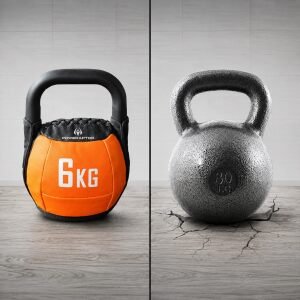
Cast iron kettlebells are familiar to gym buyers, but they are not ideal for every sales channel. They can damage floors, create noise, intimidate beginners, and increase shipping weight. Soft kettlebells solve a different problem. They are designed for floor-safe strength training, home fitness packages, beginner programs, boutique gyms, hotel gyms, school fitness rooms, rehabilitation training, and retail channels where comfort and presentation matter.
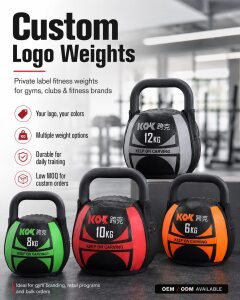
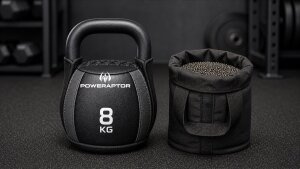
For private label buyers, the advantage is customization. A fabric or leather-look shell gives more room for brand color, logo placement, weight marking, hang tags, instruction inserts, barcode labels, and retail cartons. That makes the product easier to build into a branded fitness line instead of selling a commodity weight.
Logo Printing: Keep the Artwork Practical
Logo design is one of the first details to confirm. A curved soft kettlebell body is not the same as a flat box or metal plate. Artwork should be clean, flat, and production-friendly. Poweraptor recommends a 2D vector-style logo, clear color separation, and screen printing controlled within three colors for stable bulk production.
Buyers should avoid complex shadows, 3D emboss effects, fine gradients, and texture-heavy artwork unless the production method has already been tested. These details may look good in a digital mockup but can become distorted on curved panels or damaged during repeated training use.
Before mass production, confirm the logo size on each weight. A 4 kg kettlebell and a 12 kg kettlebell do not always use the same printable panel size. The logo and weight label should be scaled by product shape, not copied blindly across every SKU.
MOQ: What Buyers Should Ask Before Sampling
MOQ depends on how much customization is required. A standard shell color with logo printing normally needs a lower MOQ than a fully customized colorway, new panel layout, custom packaging, or new weight range. Buyers testing a market should begin with practical choices instead of trying to customize every detail at once.
For first orders, ask the factory to separate sample cost, logo setup, packaging setup, bulk MOQ, and estimated lead time. This gives a clearer view of landed cost and margin. A low unit price is not useful if the project requires too many SKUs, too many carton types, or packaging that increases freight cost.
Best Weight Range for Retailers and Studio Gyms
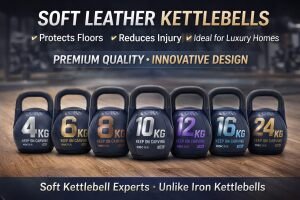
Most wholesale buyers should start with a simple range. For retail and Amazon-style programs, 4 kg, 6 kg, 8 kg, 10 kg, and 12 kg are practical starter weights. They are easy to explain to home users, beginners, women’s fitness programs, and general functional training customers.
For studios and commercial gyms, buyers may add heavier options depending on training style. However, too many weights can make inventory harder to manage. A distributor usually needs a clean first line, stable repeat production, and clear carton planning before expanding into every possible SKU.
Packaging, Carton Size, and Shipping Risk
Packaging is not decoration. For wholesale soft kettlebells, packaging affects product protection, warehouse handling, freight cost, online reviews, and retail presentation. Buyers should confirm whether the product needs a polybag, hang tag, color box, instruction insert, barcode, master carton, or pallet plan.
Carton weight must be controlled carefully because kettlebells are dense products. A carton that looks efficient on paper may become difficult to lift, easy to break, or expensive to ship. For Amazon sellers, carton labels, FNSKU labels, country of origin marking, and product photos should be confirmed before shipment.

Factory Checks Before Placing a Bulk Order
A reliable soft kettlebell supplier should be able to explain the product structure clearly. Ask about the outer shell material, handle reinforcement, inner filling bag, iron sand or weighted filling, stitching method, closure control, weight tolerance, and inspection process.
The handle is a high-stress area. The top cap, side panels, bottom edge, and handle base should be checked carefully. For fabric weighted fitness equipment, weak stitching is one of the fastest ways to create leakage, shape collapse, and customer complaints.
Buyers should ask for sample photos, packing photos, weight confirmation, and pre-shipment checks. A factory that understands private label orders should confirm artwork, color, logo position, carton marks, and packing details before production begins.
Build a Product Line, Not Only One SKU
Soft kettlebells can work better when they are part of a broader functional training line. Distributors and gym suppliers can combine soft kettlebells with Power Bags, Bulgarian Bags, Soft Plyo Boxes, wall balls, boxing bags, and protective training gear in one container program.
This matters because B2B buyers often want supply efficiency. A single supplier that can support multiple fabric-based strength and combat products can reduce communication cost, simplify packing plans, and help buyers test related categories without building a new supply chain for every SKU.
Work With Poweraptor
Poweraptor supplies private label soft kettlebells and fabric weighted fitness equipment for wholesale buyers, gym suppliers, distributors, retailers, Amazon private-label sellers, and fitness brands. We focus on OEM and ODM bulk production, not one-piece personal customization.
If you are building a private label soft kettlebell line, send your target weights, logo file, color preference, packaging plan, order quantity, and destination country. Our team can help review MOQ, materials, logo placement, carton packing, sample options, and related products for a more complete wholesale program.